1. Executive Summary: The Unified Intelligence Layer
Cloudastructure (CSAI) is executing a structural pivot from a „video surveillance“ company to a „Unified Risk Intelligence“ platform. While the market currently values CSAI as a micro-cap hardware reseller (trading at ~3.0x 2027E EV/Revenue), the underlying fundamentals tell the story of a burgeoning high-margin SaaS player in the making.
The investment thesis rests on three pillars:
The Flex Security Ecosystem: A new strategic partnership that unlocks the massive construction and critical infrastructure markets via autonomous robotics and drones.
Vertical Dominance: Deep penetration into the top 10 NMHC multifamily firms.
Hardware Agnosticism: A „Trojan Horse“ strategy that avoids rip-and-replace costs.
2. The Flex Security Partnership & Drone Integration
One of the most significant catalyst for 2026 is the strategic expansion of the Alpha™ Mobile Surveillance Trailer, a platform developed in partnership with Flex Security (a division of RVMP). This collaboration marks a pivotal shift for Cloudastructure, moving the company beyond its traditional fixed-camera software model and into the high-demand market for rapid-deployment, off-grid security and drone surveillance solutions.
The „Alpha“ Ecosystem: A Unified Intelligence Layer
The Alpha platform is designed as a self-sufficient security node capable of operating in remote environments without existing power or internet infrastructure.
- Hardware Foundation: The trailer is a solar-powered, autonomous unit featuring a 27-foot mast, integrated Starlink/5G connectivity for reliable data transmission, and edge-AI processing capabilities that allow for immediate threat detection even in low-bandwidth scenarios.
- The Drone Layer: On January 21, 2026, CSAI announced a game-changing integration of autonomous drones into the Alpha platform. Unlike standalone drones that require a pilot, these units are fully integrated into the trailer’s ecosystem. They launch automatically when the ground-based AI detects an alert, providing „eye-in-the-sky“ verification for remote guards. This capability eliminates blind spots and allows operators to visually inspect threats that may be obscured from ground level.
- Why It Matters: This integration transforms the Alpha unit from a passive recording device into an active, robotic security guard. It enables CSAI to effectively secure massive, sprawling perimeters—such as solar farms, logistics yards, and large construction sites—where fixed cameras are often impractical or cost-prohibitive.
Market Validation & Commercial Traction
The industry has quickly recognized the value of this integrated approach.
- Award Winning: The Alpha platform was named „Project Management Solution of the Year“ at the 2025 PropTech Breakthrough Awards, signaling strong product-market fit within the real estate technology sector.
- Commercial Success: The platform’s first major commercial deployment occurred in May 2025 with a national renewable energy contractor. In this instance, the Alpha trailer replaced an inadequate legacy provider, validating CSAI’s ability to win competitive bids in the $300M–$1B annual construction theft market. This early traction serves as a „proof of concept“ for the broader industrial sector, creating a replicable sales motion for future enterprise clients.
3. Core Growth Drivers
A. The „Land and Expand“ Flywheel: Unlocking the Multifamily Monopoly
The primary engine of Cloudastructure’s medium-term growth is not dependent on speculative new customer acquisition, but rather on the systematic penetration of its existing blue-chip client base. The company has successfully secured Master Service Agreements (MSAs) with 6 of the top 10 NMHC-ranked property management firms, effectively embedding its technology into the operational fabric of the nation’s largest landlords. This concentration creates a massive, de-risked organic pipeline: these five clients alone manage over 10,000 properties representing 1.9 million individual units.
The math behind this expansion opportunity is compelling. Even assuming a conservative Annual Contract Value (ACV) of $50,000 per location (blending hardware installation with recurring SaaS fees), fully penetrating just these five accounts represents a $500 million+ revenue opportunity. This „land and expand“ strategy is underpinned by an elite ~98% customer retention rate, a metric that serves as arguably the strongest validation of the platform’s utility. Once Cloudastructure’s AI is installed, it becomes operationally indispensable, creating a „sticky“ recurring revenue stream that compounds as clients migrate from single-site pilots to portfolio-wide deployments.
B. Deal Size Acceleration: The Shift to Portfolio-Scale Economics
We are actively witnessing a shift in contract mechanics that signals the business is graduating from an „experimental“ vendor to a real infrastructure partner. In 2022, the average deal size was a modest ~$14,000, reflecting tentative, single-building pilots. By 2024, this figure had nearly tripled to ~$40,000 as early adopters began expanding their footprints.
Entering 2026, this trend has accelerated, evidenced by the recent announcement of a record-breaking deployment exceeding $450,000. This jump confirms that major institutional clients are moving toward portfolio-level commitments rather than piecemeal adoption. Crucially, management has confirmed the operational infrastructure is already in place to support this velocity, with the current capacity to onboard 20+ new locations per month. This ensures that the rapid scaling of deal flow will not be throttled by implementation bottlenecks, preserving the company’s reputation for execution speed.
C. Margin Expansion via „Remote Guarding“ Saturation
While revenue growth grabs headlines, the most critical driver for valuation re-rating is the structural improvement in unit economics driven by the „Remote Guarding“ service. This premium offering—where AI alerts trigger live human intervention—is seeing rapid adoption, with an attach rate of approximately 1/3 on all new deployments.
This dynamic is engineering a fundamental mix-shift in the P&L. As the ratio of revenue moves away from lower-margin, one-time hardware sales and toward high-margin, recurring software subscriptions, the company’s gross margin profile expands naturally. This transition is the central lever in management’s path to their long-term Adjusted EBITDA margin target of 25%+. Effectively, every new Remote Guarding subscription acts as a layer of high-quality, compounding profit, accelerating the company’s trajectory toward cash-flow positivity even faster than top-line revenue growth would suggest.
4. Financial Health & Capital Structure
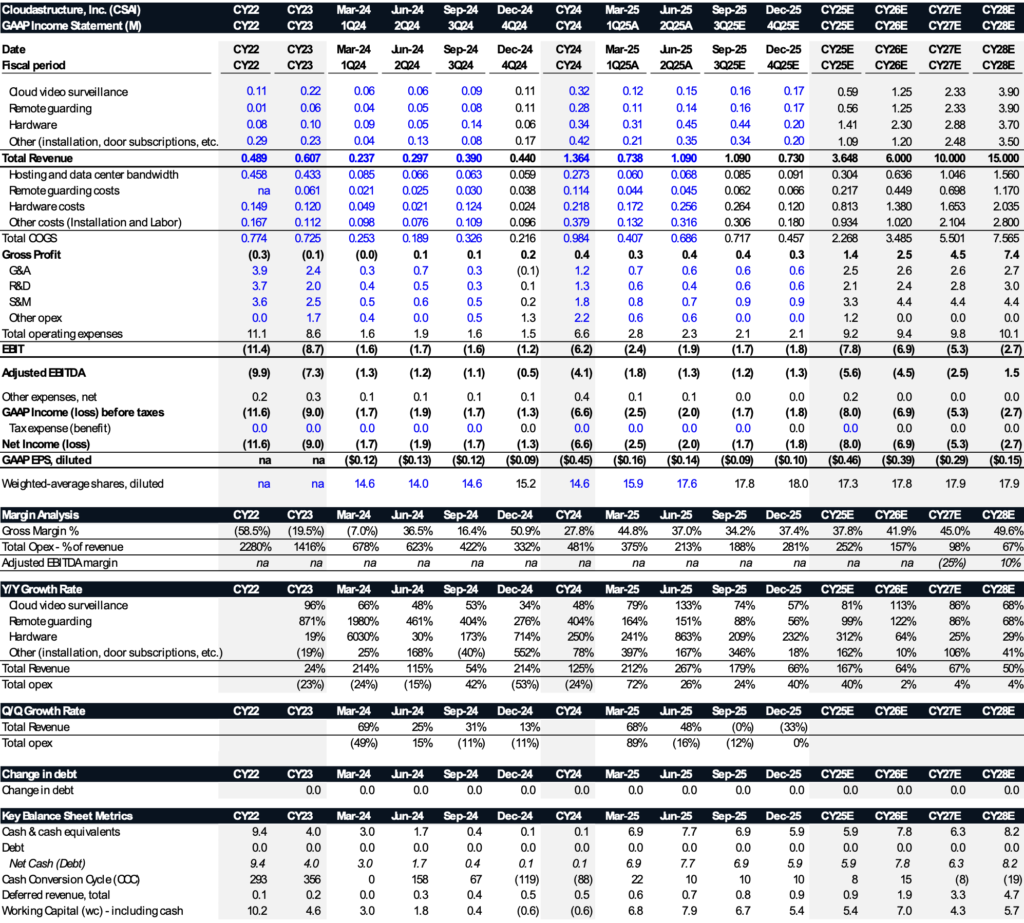
Despite its micro-cap status, Cloudastructure maintains a robust liquidity profile that could de-risks the „capital exhaustion“ bear case often associated with high-growth technology firms.
Balance Sheet Strength
The company ended 2025 with a preliminary cash position of approximately $6.4 million and zero debt, providing a clean capital structure to fund near-term operations. This solid foundation is bolstered by a disciplined approach to cash management, even as the company scales its high-velocity „land-and-expand“ strategy.
Liquidity Backstops & Strategic Capital
To further insulate operations from market volatility, Cloudastructure has secured significant access to standby capital:
- $50M Equity Line: A committed equity purchase agreement available for Class A common stock, providing flexible access to capital on demand.
- $40M Preferred Line: A securities purchase agreement for Series 2 convertible preferred stock, adding a layer of strategic financing capacity.
Runway Analysis
Based on current burn rates and the projected revenue ramp from its $6.3 million total contract value, existing cash-on-hand is sufficient to support 9–12 months of organic growth. The combined $90 million in available equity and preferred lines acts as substantial „dry powder“.
5. Valuation Framework
Current Valuation & Peer Comparison Cloudastructure (CSAI) currently trades at approximately 3.0x 2027E EV/Revenue. This valuation stands in contrast to high-growth SaaS and AI-security peers such as Alarm.com (ALRM) and the privately held Verkada, which typically command forward revenue multiples in the range of 8.0x – 12.0x.
The Market Disconnect: The current market pricing effectively prices CSAI for „execution failure,“ valuing it as a commoditized hardware reseller rather than a scalable AI platform. A relatively modest mean-reversion to a 6.0x–8.0xmultiple—still representing a significant discount to best-in-class peers—would imply multi-bagger upside from current levels.
Primary Catalyst: The $500M „Embedded Option“ While the technical pivot to autonomous drones provides „blue sky“ industrial upside, the immediate, tangible justification for a valuation re-rating lies within the company’s existingcustomer book. The market has largely ignored the „sleeping giant“ pipeline Cloudastructure has already secured: 6 of the top 10 NMHC-ranked property management firms.
- These five clients as mentioned before alone represent a combined portfolio of over 10,000 properties and 1.9 million individual units. Even assuming a conservative deployment model of $50,000 Annual Contract Value (ACV) per location (blending hardware, installation, and the high-margin Remote Guarding subscription), fully penetrating just these five existing relationships represents a $500 million+ annual revenue opportunity.
- This is not theoretical TAM; it is actionable pipeline. The recently announced record-breaking $450,000+ deployment with a global real estate investment firm serves as the „starting gun“ for this catalyst. It proves that tier-1 clients are moving past the experimental phase and are beginning to actively roll out the solution across their broader portfolios.
Conclusion on Valuation Investors often discount micro-cap stocks due to high Customer Acquisition Costs. Cloudastructure’s setup negates this risk because the clients are already acquired; the sales motion is now purely about expansion. As the company begins to convert this $500M pipeline over the next 36 months, the „Land and Expand“ flywheel will drive a decoupling of revenue growth from sales & marketing spend. This operating leverage, combined with the technological differentiation of the Flex Security partnership, provides the fundamental basis for upside momentum.
6. Key Investment Risks
While the fundamental trajectory of Cloudastructure points toward a valuation re-rating, the path is not without significant structural and execution risks. We view CSAI as an investment where the primary downside drivers are regulatory friction, sector inertia, and capital structure mechanics.
A. Execution Friction in the Industrial Pivot (Adoption Lag)
The strategic expansion into the $1 billion+ construction security market via the Alpha trailer represents the company’s largest greenfield opportunity, yet it also introduces significant execution risk. Unlike the multifamily housing sector, which is increasingly data-driven and centralized, the construction industry remains fragmented and notoriously slow to digitize. There is a tangible risk that sales cycles for high-tech, AI-enabled trailers will face friction against legacy procurement habits, where General Contractors (GCs) often default to the „lowest common denominator“ (e.g., cheap, non-intelligent cameras or physical guards) rather than investing in ROI-positive technology.
- The Mitigant: The „pain point“ in this sector is acute and quantifiable. With construction theft costing the industry an estimated $300 million to $1 billion annually, the Alpha trailer is not a discretionary luxury but a bottom-line necessity. Early wins with national contractors suggest that once the „Loss Prevention“ ROI is demonstrated, adoption can scale rapidly, bypassing traditional IT procurement hurdles.
B. Regulatory Tail Risk: The FAA & BVLOS Dependency
The scalability of the new autonomous drone service is inextricably linked to the evolving regulatory landscape of the Federal Aviation Administration (FAA). The long-term margin thesis for aerial security relies on „one-to-many“ remote operations—where a single guard manages multiple drones simultaneously. This „human-out-of-the-loop“ model depends heavily on favorable rulings regarding Beyond Visual Line of Sight (BVLOS)operations. If regulatory progress stalls or if final rulings are overly restrictive (requiring visual observers on-site), the unit economics of the drone service would degrade, potentially capping the total addressable market.
- The Mitigant: Cloudastructure’s operational domain provides a natural regulatory buffer. Unlike drone delivery services that must navigate complex public airspace over populated cities, CSAI’s drones operate primarily within private, controlled perimeters (fenced logistics yards and construction sites). This „private property“ distinction significantly lowers the regulatory hurdle for waivers compared to broader commercial drone applications.
C. Capital Structure & Dilution Overhang
For micro-cap investors, dilution is the primary enemy of total return. While the company’s balance sheet is currently healthy with zero debt, the existence of the $50 million equity line creates a technical overhang on the stock. The risk is not necessarily insolvency, but rather „inefficient scaling.“ If the stock price remains depressed, utilizing this facility to fund growth becomes expensive in terms of share count, potentially permanently diluting early shareholders before the fundamental thesis plays out.
- The Mitigant: Management has demonstrated commendable capital discipline, utilizing the equity line sparingly. By prioritizing a path to cash-flow breakeven by 2027, the company aims to self-fund its growth, treating the equity line as an emergency backstop rather than a primary checking account. If revenue acceleration continues at the current triple-digit pace, the company may outgrow its reliance on external equity sooner than the market anticipates.
7. Current Developments (Q1 2026 Update)
Since the initial formulation of this thesis, Cloudastructure has announced a flurry of commercial developments throughout January and February 2026. These updates provide direct, real-world validation of the primary growth catalysts outlined above, effectively transitioning the company from a „show-me“ story to an execution phase.
Validation of the „Land and Expand“ Flywheel The cornerstone of our valuation framework was the $500M+ embedded organic pipeline stemming from CSAI’s deep penetration into the top NMHC multifamily firms. Recent press releases confirm that this „land and expand“ strategy is actively bearing fruit:
- Market Share Expansion: On February 12, 2026, Cloudastructure announced it was selected by yet another Top-15 NMHC operator for a flagship luxury property in Houston. With this addition, CSAI now actively protects properties for 8 of the Top 15 property management companies in the U.S.
- Portfolio-Scale Economics Realized: Validating our premise that single-site pilots are graduating to portfolio-wide commitments, CSAI announced on February 5, 2026, the expansion of a partnership with a large, national Southeast multifamily operator. Following a successful pilot, the operator expanded the deployment from a single property to four properties across major Southern metropolitan markets.
- The Remote Guarding Catalyst: Both of these NMHC deployments center heavily on Cloudastructure’s high-margin „Remote Guarding“ service, which the company now notes boasts a documented 98% crime deterrence rate. As operators face rising insurance premiums and massive liability pressures (what management refers to as „social inflation“ and „nuclear verdicts“), this proactive intervention model is rapidly becoming a non-negotiable operational standard, driving the margin expansion we anticipated.
Accelerated Execution in Off-Grid and Industrial Markets Our thesis highlighted the Alpha™ Mobile Surveillance Trailer and drone integration as a critical „blue sky“ opportunity to secure massive, sprawling perimeters like construction sites and solar farms.
- Critical Infrastructure Penetration: On February 19, 2026, the company announced the commercial deployment of its first fully off-grid, solar-powered security enclosures across critical infrastructure sites in Maryland, Ohio, and Illinois. Securing large-scale solar fields and enterprise energy operators proves that the company’s hardware-agnostic, AI-driven platform can successfully navigate the procurement friction of the industrial sector.
- Rapid Geographic Scaling: Driven largely by the massive demand for these Mobile Surveillance Trailers (equipped with the integrated aerial drone support we noted), Cloudastructure announced on January 29, 2026, that it has expanded its footprint into five new states. The company now actively operates in 28 states plus Washington, D.C.
Conclusion: The Inflection Point
Cloudastructure is currently navigating the most critical phase of its corporate lifecycle: the transition from „venture-funded experiment“ to „cash-flow positive compounder.“ The setup for 2026 is defined by a clear, albeit capital-intensive, strategy to capture the massive embedded value within its existing customer base.
The Growth Engine: Accelerating Hardware to Lock in Margins
The path to positive cash flow is counter-intuitive: Cloudastructure must aggressively spend capital now to secure long-term profitability. The company needs to ramp up hardware installations—evident in the recent 790% surge in installation revenue—to physically entrench itself within client properties. This hardware acts as the „Trojan Horse“ that locks customers into the ecosystem. Once installed, the revenue mix shifts toward the high-margin, recurring Remote Guarding and AI SaaS subscriptions (which grew 154% and 142% respectively). Investors should view the current cash burn not as operational waste, but as the customer acquisition cost (CAC) required to build a sticky, high-margin annuity stream for the next decade.
The Upside Catalyst: A $500 Million Organic Pipeline
The most compelling bullish argument is the „sleeping giant“ pipeline within the company’s current book of business. With 5 of the top 10 NMHC property managers already under contract, the sales motion has shifted from hunting for new logos to farming existing acreage. Expanding these five relationships to full portfolio penetration represents a $500 million annual revenue opportunity. This organic growth lever allows CSAI to scale revenue without a proportional increase in sales and marketing expense, driving the operating leverage needed to reach profitability.
The Technological Moat: Autonomous Robotics
The strategic pivot into autonomous drones via the Flex Security partnership fundamentally expands the Total Addressable Market (TAM). By integrating aerial robotics into the Alpha mobile trailer, Cloudastructure is no longer just competing with camera software; it is replacing the entire physical security labor force. This move into industrial robotics provides a secondary growth engine beyond multifamily housing, targeting high-value infrastructure projects that demand premium pricing.
The Financial Reality: High Burn vs. Clean Balance Sheet
Finally, investors must weigh the company’s pristine capital structure against its operational burn. Cloudastructure holds zero debt, a rarity for a micro-cap of this profile, but its cash burn rate remains high as it funds this rapid expansion. The available $50 million equity line provides the necessary bridge to liquidity, but it also signals potential future dilution. The thesis requires a high degree of conviction that the accelerating revenue growth (approx. 270% YoY) will outpace the burn, allowing the company to reach cash-flow breakeven before it fully exhausts its non-dilutive runway.
Final Verdict
Cloudastructure offers a high-risk, high-reward entry point into the „AI industrialization“ of physical security. The strategic pivot to autonomous robotics and the activation of a $500M organic pipeline provide a credible fundamental path to a $6.00+ valuation. However, the investment thesis is not without significant friction.
The „Show Me“ Dynamic of 2026 Investors must recognize that the bridge to positive cash flow—specifically throughout fiscal year 2026—will be plagued by uncertainty. The current valuation discount (trading at ~3.0x forward revenue vs. 11.0x peers) exists because the market has not yet priced in the durability of the company’s recent performance. Until Cloudastructure demonstrates it can sustain this triple-digit growth rate over consecutive quarters without relying heavily on its equity line, the stock will remain a volatile „show-me“ story.
The burden of proof is squarely on management. They must convert the massive backlog of low-margin hardware installations into high-margin recurring revenue before the cash runway tightens.
Bottom Line: For conservative investors, the volatility of 2026 may be unpalatable. But for those with the risk tolerance to weather this period of skepticism, the disconnect between CSAI’s intrinsic value (driven by zero debt and a $500M pipeline) and its distressed market price offers one of the most asymmetric risk/reward profiles in the micro-cap software sector.