
LandBridge Company LLC (NYSE: LB; NYSE TX: LB) has reported its financial and operational results for the second quarter ended June 30, 2026. Demonstrating the ongoing strength of its active surface management model in the Delaware Basin, LandBridge delivered substantial top-line revenue growth, expanded profitability, and accelerated commercial traction in non-traditional energy assets—most notably West Texas power and digital infrastructure.
Key Q2 2026 Financial Highlights
LandBridge delivered strong year-over-year (YoY) and quarter-over-quarter (QoQ) financial results across key financial metrics:
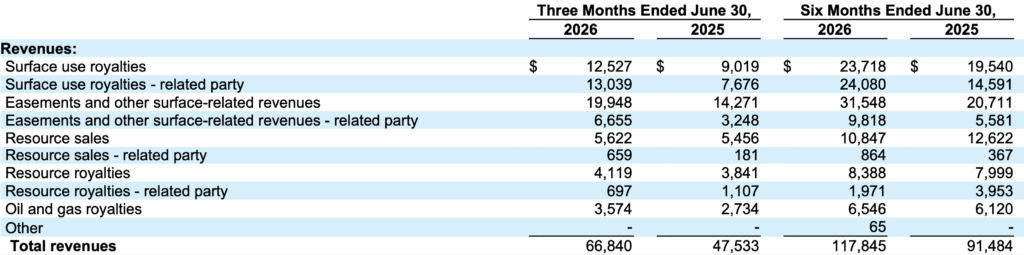
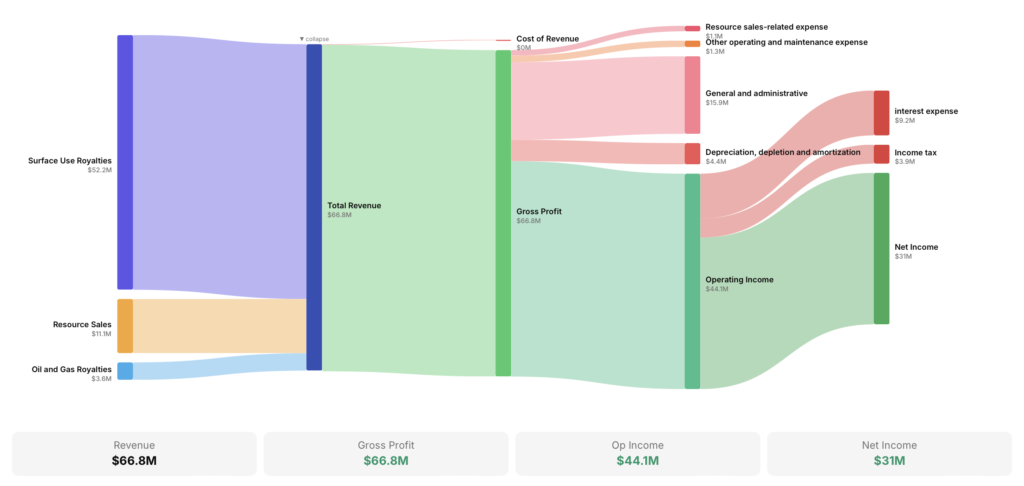
- Total Revenue: $66.8 million, representing a 41% increase YoY and a 31% increase QoQ.
- Net Income: $31.0 million, up 68% YoY and 74% QoQ, delivering a net income margin of 46%.
- Adjusted EBITDA: $59.8 million (up 41% YoY and 33% QoQ), maintaining a high Adjusted EBITDA Margin of 89%.
- Cash Flows from Operations: $41.4 million, up 11% YoY with an operating cash flow margin of 62%.
- Free Cash Flow: $40.2 million, up 11% YoY, yielding a 60% Free Cash Flow Margin.
- Quarterly Dividend: Announced a cash dividend of $0.12 per share.

Revenue Stream Breakdown: Long-Term, Fee-Based Royalties
LandBridge’s revenue model focuses on capturing surface royalties and infrastructure usage fees. For Q2 2026, the company’s revenue streams breaks down as follows:
- Surface Use Royalties & Revenues: $52.2 million (78% of total revenue).Driven by produced water transportation, handling operations, skim oil recovery, waste reclamation, well pad access, roads, and pipeline/utility easements.
- Resource Sales & Royalties: $11.1 million (17% of total revenue).Comprising sales of brackish water for well completions, caliche sales for access roads, and sand mining royalties.
- Oil & Gas Royalties: $3.6 million (5% of total revenue).Direct royalties from net mineral acreage, reflecting the company’s intent to maintain a low-commodity-exposure profile. Non-O&G royalty revenue represented 95% of total revenue for the quarter.
Operations & Growth Catalysts
1. Accelerating the West Texas Digital Infrastructure & Power Thesis
LandBridge is actively driving a paradigm shift in how surface acreage in the Permian Basin is commercialized, moving aggressively to capture value from the nationwide demand for data center capacity and power generation. The Delaware Basin has emerged as an ideal candidate for digital infrastructure due to cheap, abundant natural gas for power and vast contiguous acreage, but development hinges on solving three core bottlenecks: land access, massive power infrastructure, and cooling water.
LandBridge’s business model directly solves these hurdles by aggregating all critical project requirements into a single platform:
- Power Generation Potential: LandBridge disclosed that it is currently under letter of intent (LOI), option, or late-stage negotiations with 7 distinct power and digital infrastructure counterparties. Together, these prospective deals represent over 10 GW of power generation potential.
- Commercialization Flexibility: Revenue models under negotiation span initial lease option payments, construction/damage fees, long-term surface lease revenues, utility easements, and power royalty structures.
- Integrated Site Logistics: LandBridge is positioning its land to host behind-the-meter (BTM) natural gas power plants, solar generation, battery storage, and utility-scale fiber optic connections directly adjacent to proposed hyperscale data center facilities.
2. The Water Access Moat: Unlocking Brackish & Treated Water Resources
A primary differentiator for LandBridge’s digital infrastructure offering is its vast water portfolio, which is vital for data center cooling requirements without impacting municipal or agricultural supplies.
- Scale of Resource Access: LandBridge’s surface portfolio grants access to an estimated 13.4 million acre-feet of independently verified brackish water. To put this in perspective, a 1 GW data center operating over a 25-year lifespan requires approximately 118,000 acre-feet of water; LandBridge’s asset base covers this footprint many times over.
- Brackish vs. Treated Produced Water: Near-term reliability is anchored by brackish water, which benefits from established Texas Commission on Environmental Quality (TCEQ) regulatory frameworks, low treatment/desalination requirements, and direct tie-ins to existing wells. Long-term, LandBridge and its key partner, WaterBridge Infrastructure, are positioning treated produced water (supported by favorable state legislation like SB-7 and HB-49) as a sustainable industrial cooling alternative.
3. Strategic M&A: Expanding Core Delaware Basin Footprint
LandBridge continues to execute its disciplined acquisition strategy, acquiring under-utilized surface assets to overlay with its active management framework:
- Northern Delaware Basin Landfill Acquisition: The company entered into a definitive agreement to acquire 560 acres of fee surface underlying the Northern Delaware Basin Landfill in Lea County, New Mexico, for a total consideration of $20 million. The transaction, expected to close in Q3 2026, expands LandBridge’s surface ownership in commercial non-hazardous oilfield waste disposal.
- Acreage Expansion: Total owned and managed surface now exceeds 325,000 surface acres in the heart of the Delaware Basin. LandBridge’s surface economic efficiency on its legacy acreage has scaled from $465/acre in FY 2022 to $1,159/acre in FY 2025, demonstrating the platform’s ability to drive organic cash flow compounding on acquired land.
4. Synergistic Partnership with WaterBridge Infrastructure
LandBridge’s symbiotic relationship with WaterBridge Infrastructure (NYSE: WBI) continues to serve as a baseline engine for steady fee collection:
- Volume Drivers: In Q2 2026, produced water handled across LandBridge acreage averaged 2,002,506 barrels per day (BPD), alongside 170,770 BPD of brackish water sales and 6,940 tons/day of sand royalties.
- Long-Term Water Disposal Advantage: As the Stateline Area of Interest (AOI) experiences reservoir over-pressurization—projected to reduce Stateline disposal capacity by ~28% by 2028—LandBridge’s ownership of >2 MMbbl/d of permitted, low-pressure disposal capacity becomes an increasingly critical asset for regional E&Ps needing durable water handling solutions.
5. Corporate Redomicile to Texas
Following a positive recommendation from a special committee of independent directors, the Board of Directors unanimously approved converting and redomiciling the company from a Delaware limited liability company to a Texas corporation. This move aligns LandBridge’s corporate charter with its operational headquarters, major asset base, and the broader business environment of Texas.
Balance Sheet & Credit Facility Upsize
LandBridge maintained a strong leverage profile during the quarter while enhancing liquidity post-quarter end:
- Leverage Profile (as of June 30, 2026): Net Debt stood at $505.4 million ($545.2 million total debt less $39.8 million cash), with a Net Debt / Covenant EBITDA ratio of 2.5x, aligning with the company’s long-term target of 2.0x–2.5x.
- Enhanced Liquidity: On August 4, 2026, LandBridge increased its revolving credit facility borrowing base by $100 million to $375 million, reducing borrowing costs by 25 basis points across the pricing grid and boosting total available liquidity to $370 million.
Regarding the earnings call
1. Delaware Landfill Acquisition & M&A Pipeline
- Deal Economics: The $20M surface acquisition implies a high single-digit run-rate multiple with room to improve as revenue grows. It provides surface option value beyond current landfill royalties and aligns royalty rates with other WaterBridge-operated sites.
- Strategic Fit: McNeely emphasized that LandBridge would execute this deal with any third party, not just WaterBridge.
- M&A Outlook: The acquisition pipeline remains robust, particularly for potential larger opportunities in the second half of the year. Pricing expectations remain stable, and post-IPO visibility has improved LandBridge’s transaction conviction without negatively impacting deal economics.
2. Power & Digital Infrastructure / Data Centers
- Commercial Progress: LandBridge is actively engaging with 7 power and digital infrastructure counterparties—a mix of hyperscalers, EPCs, and power generation firms. Discussions are well-advanced, involving either signed agreements undergoing diligence or final document negotiations.
- 12-Month Expectations: LandBridge expects to convert multiple LOIs and options into firm leases, with revenue contribution anticipated by late 2026.
- 10+ GW Pipeline Risking: Management noted that the stated 10+ GW pipeline figure has been conservatively risked to mitigate concentration risk; the total active queue is actually larger.
- Regulatory/Grid Concerns (ERCOT Audit): McNeely addressed recent Texas regulatory directives, noting they are insulated because LandBridge projects rely on behind-the-meter, co-located power (often net exporters to the grid), utilize brackish/treated produced water for cooling, and occupy large contiguous acreage in supportive local communities.
3. Water Management & Produced Water Royalties
- Q2 Outperformance: Produced water volumes saw a ~15% sequential increase from Q1 to Q2 (beating expectations of ~5%), driven by WaterBridge bringing assets online ahead of schedule. While a further volume ramp is expected in H2 (driven by the Speedway asset), the growth rate will be less pronounced than Q1-to-Q2.
- Royalty Rates & Pore Space Scarcity: Prevailing rates for new facilities are currently around $0.15/barrel for both WaterBridge and third parties. Management expects royalty rates to drift upward over time due to increasing pore space scarcity along the Texas/New Mexico state line.
Conclusion
LandBride once again delivered phenomenal results. We like to see management is executing quarter after quarter and is truly consistent. While the company is approaching our fair value target (at current economics) around $100, the stock is getting expensive, strong full year results could drive the fair value target further. Buyers at current levels need to be well aware of the short to mid term volatility, that pose a major downside risk, note that this is not driven by eroding fundamental or thesis but short to mid term irrational market sentiment. We remain very bullish on west Texas and believe that LandBride will be a long term winner and will be able to continuously create wast shareholder value, as they control the most valuable resources (Land and Water).