
Brookfield Corporation (BN), a premier global investment firm managing over $1 trillion in assets under management (AUM), reported a robust Q1 2025, showcasing its ability to generate high-margin, diversified cash flows across its Asset Management, Wealth Solutions and Operating Businesses segments. With investments in real estate, renewable power, infrastructure, private equity, and credit, BN’s capital-light model, record deployable capital, and strategic capital allocation drove significant earnings growth. The Q1 2025 highlights BN’s operational resilience, financial strength and growth trajectory, positioning it as a leader in alternative asset management.
Financial Performance
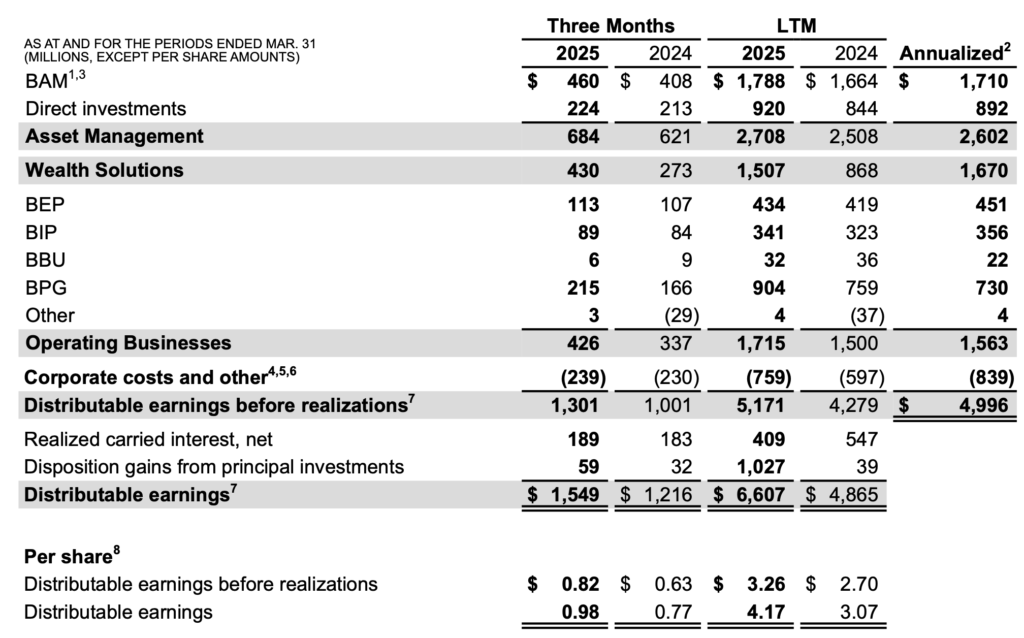
BN’s financial results for Q1 2025 reflect strong growth in its primary performance metric, Distributable Earnings (DE), which measures cash flows available for distribution or reinvestment. The company reported $1.549 billion in DE ($0.98 per share) for Q1 2025, a 27% increase from $1.216 billion ($0.77 per share) in Q1 2024. DE before realizations, a proxy for recurring cash flows, was $1.301 billion ($0.82 per share), up 30% from $1.001 billion ($0.63 per share) in Q1 2024, driven by organic growth across all segments. Over the last twelve months (LTM), DE reached $6.607 billion ($4.17 per share), with DE before realizations at $5.171 billion ($3.26 per share), a 21% per-share increase from 2024.
Segment Contributions to DE in Q1 2025 were:
- Asset Management: $684 million ($0.43 per share), up 10% from $621 million in Q1 2024 (page 6). This includes $460 million from Brookfield Asset Management (BAM) and $224 million from distributions on direct investments. Record fee-related earnings (FRE) of $698 million, a 26% increase from Q1 2024, were driven by a 20% rise in fee-bearing capital to $549 billion. Realized carried interest of $189 million further boosted DE.
- Wealth Solutions: $430 million ($0.27 per share), a 58% increase from $273 million, reflecting $4 billion in annuity sales, a $133 billion insurance asset base, and a 5.7% portfolio yield. Statutory capital grew to $16 billion, supporting a 15% return on $11.5 billion of invested capital.
- Operating Businesses: $426 million ($0.27 per share), up 26% from $337 million. Contributions included:
- Renewable Power (BEP): $113 million, up from $107 million.
- Infrastructure (BIP): $89 million, up from $84 million.
- Private Equity (BBU): $6 million, down from $9 million.
- Real Estate (BPG): $215 million, a significant increase from $66 million, driven by higher realizations.
- Other: $3 million, improved from a $29 million loss.
Corporate Costs and Other deducted $239 million from DE, slightly up from $230 million in Q1 2024, reflecting costs like interest on corporate borrowings and equity-based compensation.
BN paid $138 million in dividends, repurchased $569 million in shares (10.4 million shares), and reinvested $2.971 billion into its businesses, including $466 million in Asset Management, $430 million in Wealth Solutions, and $1.368 billion in Operating Businesses. This reinvestment was partially funded by $380 million in net financing activities (e.g., bond issuances) and $302 million in other sources.
Net Income under IFRS was $73 million ($0.02 per share) in Q1 2025, down from $102 million ($0.04 per share) in Q1 2024. This reflects significant non-cash adjustments, including:
- Fair value changes: -$931 million, driven by market volatility impacting asset valuations.
- Depreciation and amortization: -$585 million, reflecting BN’s extensive real asset portfolio.
- Working capital changes: -$199 million, due to timing of cash flows.
- Deferred income taxes: +$283 million, a partial offset.
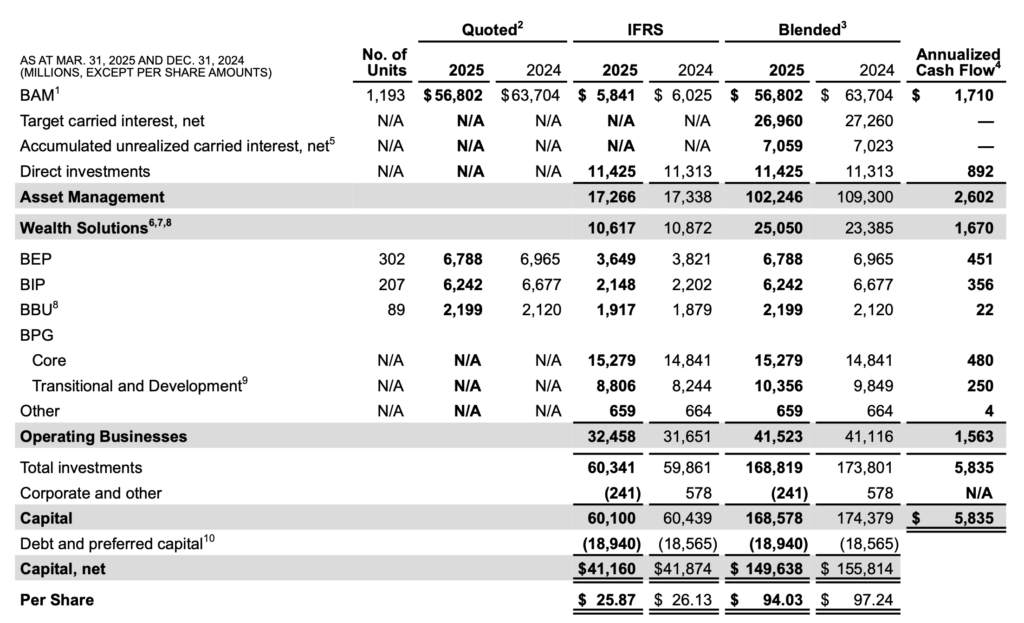
BN’s balance sheet remains a cornerstone of its strength, with $5.484 billion in corporate liquidity as of March 31, 2025, comprising $2.123 billion in cash and financial assets and $3.361 billion in undrawn credit lines. Total deployable capital reached a record $165.329 billion, including $69.068 billion in core liquidity (corporate and affiliate-level cash and credit lines) and $96.261 billion in third-party uncalled private fund commitments. Corporate borrowings totaled $13.460 billion, with a 4.7% weighted-average interest rate and a 15-year average term, with no maturities until 2026. BN also has $4.333 billion in perpetual preferred shares at a 4.9% cost, contributing to a 14% corporate debt-to-capitalization ratio based on market capitalization. Total capital was $168.578 billion (blended basis), down slightly from $174.379 billion at year-end 2024, generating $5.835 billion in annualized cash flows.
Operational Strengths
BN’s operations across its three core segments—Asset Management, Wealth Solutions, and Operating Businesses—demonstrate its diversified, high-margin model, underpinned by a global portfolio of real assets.
- Asset Management:
- Overview: Managed by Brookfield Asset Management (BAM), this segment oversees $1 trillion in AUM, with $549.067 billion in fee-bearing capital, a 20% increase from $458.625 billion in Q1 2024. BN owns a significant stake (70%) in BAM, generating $460 million in DE, plus $224 million from direct investments alongside BAM’s funds.
- Financial Performance: Q1 DE was $684 million, up from $621 million, driven by $698 million in FRE, a 26% increase from Q1 2024. Fee revenues rose to $1.300 billion from $1.113 billion, offset by $533 million in direct costs. Realized carried interest was $189 million, with $11.6 billion in accumulated unrealized carried interest, up 14% year-over-year. LTM inflows totaled $140 billion, with Q1 inflows at $25 billion.
- Operational Highlights: BN closed a $16 billion flagship opportunistic credit fund and raised $16 billion for its fifth opportunistic real estate fund, with additional closes expected to make it BN’s largest real estate pool. Fundraising momentum drove fee-bearing capital growth, with $90 billion added LTM. BAM’s focus on renewable power, infrastructure, private equity, real estate, and credit ensures diversified revenue streams.
- Key Metrics: FRE margin was ~53%, reflecting cost discipline. Annualized DE from BAM is $1.710 billion, with direct investments contributing $892 million.
- Wealth Solutions:
- Overview: Brookfield Wealth Solutions (BWS) provides retirement and wealth protection products, managing $133 billion in insurance assets as of March 31, 2025. It generated $430 million in DE, a 58% increase from $273 million in Q1 2024.
- Financial Performance: Q1 DE benefited from $4 billion in retail and institutional annuity sales, up significantly year-over-year. The investment portfolio yielded 5.7%, 1.8% above the 3.9% cost of funds, generating a 15% return on $11.5 billion of invested capital. Statutory capital grew to $16 billion, enhancing financial stability. LTM DE was $1.507 billion, with annualized DE at $1.670 billion.
- Operational Highlights: BN rotated $8 billion of American Equity Life’s portfolio to higher-yielding assets, boosting returns. BWS’s private wealth channel raised $650 million monthly, part of $2 billion in total monthly retail capital across BN’s platforms. The segment’s focus on long-duration liabilities and risk management ensures stable cash flows.
- Key Metrics: The 5.7% yield on $133 billion in assets translates to ~$7.581 billion in annualized investment income, with the 1.8% spread generating ~$2.394 billion in net income before costs, underscoring BWS’s profitability.
- Operating Businesses:
- Overview: This segment includes BN’s investments in Renewable Power (BEP), Infrastructure (BIP), Private Equity (BBU), Real Estate (BPG), and other businesses, generating $426 million in DE, up 26% from $337 million. LTM DE was $1.715 billion, with annualized DE at $1.563 billion.
- Financial Performance: Key contributors included:
- BEP: $113 million in DE, supported by stable renewable energy cash flows.
- BIP: $89 million, driven by infrastructure assets like data centers and utilities.
- BBU: $6 million, impacted by lower realizations.
- BPG: $215 million, boosted by real estate monetizations and 3% same-store NOI growth.
- Operational Highlights: BN signed 9 million square feet of office and retail leases, including 2.3 million square feet of U.S. office leases. The North American residential business generated $640 million from master plan community sales, shifting to a capital-light model. BPG’s core portfolio delivered stable cash flows, with transitional and development assets adding upside.
- Key Metrics: Real estate’s 3% NOI growth reflects resilience in a challenging market. BPG’s $730 million annualized DE highlights its outsized contribution.
BN’s capital-light model minimizes non-discretionary capital expenditures, which are not explicitly reported but implied to be low, as cash flows are primarily reinvested or returned to shareholders (page 8). This operational efficiency maximizes DE and supports growth initiatives.
Strategic Initiatives
BN’s strategic initiatives in Q1 2025 enhance its growth potential:
- Acquisitions: Post-quarter, BN acquired a majority stake in Angel Oak, a credit manager with $18 billion in AUM, strengthening BAM’s credit platform. This follows BN’s history of accretive acquisitions, aligning with its goal to expand fee-bearing capital.
- Monetization: BN closed $22 billion in asset sales at or above carrying values, generating $1.027 billion in LTM disposition gains, primarily from selling BAM shares to American Equity Life shareholders in Q2 2024. Accumulated unrealized carried interest grew 14% to $11.6 billion, with $409 million realized LTM. BN expects to realize much of this over the next five years.
- Capital Allocation: Over the LTM, BN allocated $8.532 billion to its businesses, including $2.539 billion to Asset Management (e.g., real estate and credit funds), $2.461 billion to Wealth Solutions, and $1.955 billion to Operating Businesses, primarily for debt repayment and real estate investments (page 8). BN returned $1.577 billion to shareholders via $509 million in dividends and $1.068 billion in share repurchases (21.7 million shares), with $569 million in Q1 (10.4 million shares). The press release notes $850 million in 2025 YTD repurchases, adding over 40 cents per share in value.
- Financing: BN executed $30 billion in financings, including a $500 million 30-year senior unsecured note at its tightest spread to date. LTM financing included a $700 million 30-year subordinated debt issuance and a $1 billion non-recourse loan, maintaining low-cost debt access.
- Wealth Solutions Expansion: BWS received a U.K. pension risk transfer (PRT) license, the first dedicated PRT license in the U.K. since 2007, targeting a £500 billion market over the next decade. This complements BWS’s U.S. annuity growth and enhances global scale.
Investment Outlook and Risks
BN’s $165.329 billion in deployable capital, including $96.261 billion in uncalled fund commitments, positions it to capitalize on investment opportunities in a volatile market. The $5.484 billion in corporate liquidity and $11.6 billion in unrealized carried interest provide significant flexibility for acquisitions, fund commitments, and shareholder returns. BN targets 15%+ annualized DE growth, as stated in the Supplemental Information, supported by:
- Fundraising: Continued inflows, with $25 billion in Q1 and $140 billion LTM, signal strong investor demand.
- Monetizations: A $22 billion asset sale pipeline and $11.6 billion in unrealized carried interest offer future cash flow potential.
- Segment Growth: Wealth Solutions’ U.K. expansion and Asset Management’s credit and real estate funds drive diversified earnings.
Risks include:
- Market Volatility: Rising interest rates or economic slowdowns could reduce fundraising or asset valuations, impacting FRE and carried interest. The $931 million fair value loss in Q1 highlights this risk.
- Execution Risk: Integrating acquisitions like Angel Oak or realizing $11.6 billion in carried interest depends on market conditions and performance.
- Regulatory Risks: Changes in tax laws or insurance regulations could affect Wealth Solutions’ profitability, though the U.K. PRT license mitigates this.
In conclusion, Brookfield Corporation’s Q1 2025 earnings reflect its exceptional position as a global leader in alternative asset management, showcasing robust performance across its Asset Management, Wealth Solutions, and Operating Businesses segments. Strategic advancements, including the acquisition of a majority stake in Angel Oak, significant asset monetizations, and the securing of a U.K. pension risk transfer license, reinforce Brookfield’s commitment to long-term value creation. Bolstered by substantial deployable capital and a conservatively structured balance sheet, the company is well-equipped to navigate market dynamics and pursue growth opportunities. BN continues to look very cheap at current DE, especially when considering the 27% increase. While we don’t believe BN will close the significant discount gap, this still supports a great upside potential. The BN management around Bruce Platt continues to build a diversified compounding machine that is absolutely focused on longterm success.